
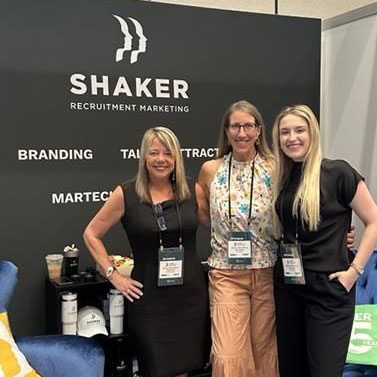
Q1 was packed with industry events that reinforced a clear message: the future of work is already here—and leaders who pair technology, trust, and human judgment will be the ones who win. Across NAHRES, IAMPHENOM, UNLEASH America, Consero, and other major conversations, a few themes consistently surfaced.
1. AI is here to stay, but structure is what makes it work
Across multiple events, the conversation around AI has moved beyond the experimental phase. The focus has shifted from testing tools to operationalizing AI responsibly and effectively. Leaders emphasized that the difference between trying AI and realizing ROI is structure: clear use cases, governance, accountability, and a realistic plan for adoption.
At IAMPHENOM, discussions highlighted how automation and agentic AI can help talent teams move from reactive to strategic by reclaiming recruiter time and reducing drop-off throughout the hiring funnel. Importantly, speakers reinforced that successful technology adoption is not reserved for enterprise organizations. Employers of all sizes can see meaningful impact when the right partners, processes, and implementation models are in place.
Consero shared a similar sentiment. AI is increasingly being discussed not as a tool, but as an integrated part of the recruiting team itself. The practical questions are changing. Instead of asking whether AI belongs in talent acquisition, leaders are asking how to present it responsibly to the C-suite, how to build trust in its use, and how to drive adoption internally.
Key takeaway: AI delivers value when organizations move beyond experimentation and build the structures needed to adopt it thoughtfully, responsibly, and at scale.
2. Human judgment is the differentiator in the age of AI
Even in rooms full of AI discussion, the strongest messages were deeply human. As leaders discussed innovation, they were equally clear about what actually makes technology adoption effective: human judgment, empathy, and trust.
At NAHRES, panels centered on inclusive leadership, transparency, and the responsibility leaders have to truly hear their teams—even when the feedback is uncomfortable. Empathy consistently surfaced as a top priority for today’s workforce, particularly among Millennials and Gen Z, often ranking higher than compensation alone.
Employees may not always be able to hear everything, but they do expect honesty, thoughtfulness, and care in how leaders communicate. In moments of uncertainty—whether that means layoffs, organizational change, or social tension—people remember how they were treated.
Spotify’s keynote perspective underscored this same idea: human judgment is a competitive advantage that separates high-performing organizations from mediocre ones. Smart risk-taking, the willingness to pivot, and learning quickly from missteps are essential leadership skills, especially as AI accelerates the pace of change.
That lesson also connected with Simon Sinek’s remarks at IAMPHENOM. High-performing individuals do not automatically create a high-performing team. Strong teams are built when leaders create a shared vision, encourage people to lift one another up, and define success collectively rather than individually.
Key takeaway: In a market (and world) shaped by rapid change, human-centered leadership is a strategic advantage.
3. Trust, transparency, and psychological safety are non-negotiable
Another unifying theme across events was that trust is the foundation of performance.
Speakers emphasized that transparency doesn’t mean having all the answers. It means communicating clearly, honestly, and thoughtfully. Leaders who explain the “why” behind decisions, acknowledge feedback, and respond with consistency build credibility, even during periods of change or uncertainty.
Psychological safety was also repeatedly cited as critical to engagement, innovation, and retention. Employees need to feel safe making mistakes, sharing ideas, and showing up as themselves at work. When people are constantly worried about saying the wrong thing, taking the wrong risk, or being left in the dark, performance suffers.
This was especially relevant in conversations about change management and leadership credibility. Organizations do not lose trust because every decision is perfect; they lose trust when leaders fail to communicate, fail to listen, or fail to repair when something does not land as intended.
Key takeaway: Trust is built through clarity, consistency, and care—and without it, even the best strategies and technologies will struggle to succeed.
4. Speed and experience matter more than ever, especially in frontline hiring
Frontline talent sessions reinforced how quickly today’s candidates move—and how costly slow processes can be. Speed, automation, and clear candidate communication were repeatedly identified as key drivers of perception and conversion.
At UNLEASH America, speakers emphasized that speed and candidate perception are tightly linked. Candidates move fast, and if the process is slow, confusing, or impersonal, employers lose momentum quickly. The message was not just to move faster for speed’s sake, but to remove friction in ways that still preserve trust and connection.
That same point came through in IAMPHENOM breakout sessions, where automation in screening and interview scheduling was helping organizations reduce drop-off, move candidates through the funnel faster, and give recruiters more time for strategic work.
Cheyenne Regional Medical Center was an especially compelling example. As a rural health system facing high demand and a limited local talent pool, every candidate interaction matters. Their use of HR technology showed that meaningful transformation isn’t reserved for large enterprises with massive resources. With the right strategy and partnership, smaller and mid-sized organizations can use automation to improve candidate flow, save recruiter time, and increase hiring outcomes.
Bright Horizons offered another strong proof point. Their event automation and campaign strategy drove more than 3,200 campus-influenced applications and 381 hires, while also improving engagement through more relevant communication. The lesson was practical: know your traffic sources, build a campaign calendar, and make it easier for candidates to engage at the right time with the right content.
At the same time, leaders cautioned against over-automation. The most effective hiring strategies strike a balance between efficiency and the human touch, ensuring candidates still feel seen and valued. Trust is built when people talk to people—not just systems.
For recruitment marketing teams, this reinforced the importance of understanding funnel performance, traffic sources, and candidate drop-off points, then using technology to remove friction without removing humanity.
Key takeaway: In today’s hiring market, speed matters—but the organizations that stand out are the ones that pair efficiency with a candidate experience that still feels human.
5. Talent strategies must reflect the realities of a multigenerational workforce
With four generations active in the workforce, speakers repeatedly warned against “peanut butter strategies” that spread the same approach across every audience. Employees have different expectations around communication, flexibility, growth, and feedback depending on their generation, and effective talent strategies are built to meet people where they are.
Gen Z and Gen Alpha were described as expecting honesty, structured feedback, and visible career paths. If employees cannot see a future at an organization, they are less likely to stay. Leaders were encouraged to move from the language of “work-life balance” to work-life harmonization, recognizing that people should not feel forced to choose between professional success and personal well-being.
These conversations also connected to broader themes around retention and early attrition. Several speakers noted that time-to-fill is not always the most meaningful metric. Retention, offer acceptance, realistic job previews, and understanding where candidates or employees disengage often provide a more accurate picture of long-term success.
This points to a more mature talent strategy overall. It is not enough to attract applicants. Organizations need to understand what candidates and employees are actually experiencing, where expectations are mismatched, and how communication, job design, and manager behavior affect outcomes over time.
Key takeaway: Organizations need to personalize experiences to different workforce needs if they want to attract, engage, and retain talent.
The big picture
Last quarter’s events made one thing clear: technology may be accelerating change, but the balance of people and technology remains the point.
Across NAHRES, IAMPHENOM, Consero, and UNLEASH America, a few themes kept coming up:
- Use AI intentionally and responsibly
- Lead with empathy, trust, and transparency
- Move quickly, learn fast, and repair when needed
- Design hiring and people strategies around real human needs
The organizations that will stand out are the ones that combine technology with trust.
This blog is based on the contributions of:
Elizabeth Newhart, VP of Talent
Sheila Spinner, VP of Business Development
Bob Stocklin, Senior Client Consultant
Ellia Melin, Marketing Events Coordinator & Generalist
Stay tuned for more insights on the Shaker 75 page as we celebrate our 75th anniversary.
Let's connect
Success is in reach. Let's unlock it together.
Get in touch with us, and take the first step towards recruitment marketing that truly resonates, achieves your goals, and exceeds your expectations.